NanoSIMS

The NanoSIMS N50L (Cameca) is a ion microprobe optimized to produce images of large chemical or isotopic variations in solid samples in which high spatial resolution is required. Like the 1280 instrument, the NanoSIMS can deliver a primary beam of Cs+ or O- to a sample surface, but focused too a smaller spot of ∼50 and 150 nm, respectively
- Lateral resolution: 50-150 nm
- Mass resolution: > 10000
The NanoSIMS N50L is equipped with a multi-collector system that allows simultaneous collection of up to 7 different isotopes. Images or maps can be generated from the lightest elements, such as H (e.g. D/H ratios), C (13C/12C ratios), N (15N/14N ratios), O (e.g. 18O/16O ratios) to the heaviest elements like uranium.

The NanoSIMS instrument belongs to the Laboratory for Biological Geochemistry (LGB), an EPFL lab led by Prof. Anders Meibom.
Recently, the LGB succeeded in developing the first CryoNanoSIMS instrument. With a cryo-workflow that includes vitrification by high pressure freezing, cryo-planing of the sample surface, and cryo-SEM imaging, the CryoNanoSIMS enables correlative ultrastructure and isotopic or elemental imaging of biological tissues in their most pristine post-mortem state. This opens new horizons in the study of fundamental processes at the tissue- and (sub)cellular level (e.g., related news: https://actu.epfl.ch/news/epfl-scientists-unlock-new-horizons-for-cryogeni-5, https://actu.epfl.ch/news/how-cryogenic-microscopy-could-help-strengthen-f-5/)
Contact

Prof. Anders Meibom
Head of NanoSIMS and Cryo-SEM
anders.meibom[at]epfl.ch
+41 (0)21 693 80 14
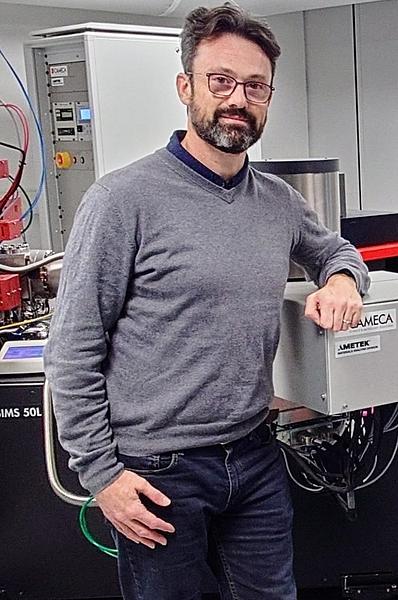
Dr. Stéphane Escrig
NanoSIMS LabManager
stephane.escrig[at]epfl.ch
+41 (0)21 692 43 73
For a review of the NanoSIMS :
Hoppe et al.-2013-NanoSIMS- Technical Aspects and Applications in Cosmochemistry and Biological Geochemistry (PDF file; 5.5MB)

